Insights.
Ideas.
Perspectives on staffing, AI, and building the workforce of tomorrow.

 Hiring Trends
The Return of Trust in Hiring
Author: TalentiFi-X Team
As applications become easier to polish, hiring teams need stronger signals of real capability. Learn why skills, impact, references, judgment and trust are becoming more important in recruitment.
 Hiring Strategy
The Future of Hiring Isn't More. It's More Precise.
Author: TalentiFi-X Team
What is precision hiring? Learn why employers are shifting from candidate volume toward skills, context, quality of hire and human judgment, supported by technology.
 Global Hiring
India Has Won the GCC Location Argument. Can We Win the Talent Argument?
Author: TalentiFi-X Team
India has become a global GCC powerhouse. The next challenge is talent capability. Explore why specialised skills, mid-senior talent, leadership and capability building will define the next phase of GCC growth.
 Talent Strategy
The Best Candidate May Never Apply
Author: TalentiFi-X Team
The best candidates may already be employed and not actively job hunting. Learn how passive candidate recruitment, proactive sourcing and talent mapping can help companies find specialised and hard-to-fill talent.
 Bulk Hiring & AI
Bulk Hiring at Scale Without Dropping Quality: How AI Screening Funnels Work
Author: TalentiFi-X Team
In AI-assisted bulk hiring, a screening funnel works like this. AI scores every applicant across 50+ parameters: technical skills, career trajectory, role fit, behavioural signals, and red flag detection. Only the top 10% of scored candidates pass to human reviewers. The quality bar is set once, at the intake stage, and held consistently across every candidate regardless of volume. This is how organisations run hiring drives of 50 to 500 roles without the quality drop that traditionally comes with scale.
 Interview Strategy
The Energy Signal: How to Decode What Candidates Tell You in Final Round Interviews
Author: TalentiFi-X Team
In a final round interview, candidate energy is the most honest signal available to a hiring manager. Energy divides into two types. Certainty energy is confidence grounded in what has already been built, best suited for roles requiring execution and stability. Change energy is restlessness and drive toward new problems, best suited for roles requiring transformation and growth. Misreading one for the other is one of the most consistent causes of strong candidates failing in roles they were technically qualified for.
 Hiring Strategy
When Your Hiring Process Keeps Breaking Down, Look at the Role, Not the Process
Author: TalentiFi-X Team
When a hiring process repeatedly breaks down, extending timelines, producing wrong shortlists, or collapsing at the offer stage, the cause is almost never the process itself. It is an underdefined role upstream. Process chaos is a symptom. The role definition is the disease. Fixing the process without fixing the role is like treating a fever without treating the infection.
 Tech Hiring
Why the Best Engineers in Bengaluru Are Evaluating Your Company as Hard as You're Evaluating Them
Author: TalentiFi-X Team
The best engineers in Bengaluru in 2026 evaluate four things before accepting any offer, from any company, Indian or US. Speed of process: how long from first contact to offer. Brief clarity: how well the company communicated the role and its expectations. Recruiter quality: whether the person who reached out treated them as a professional or a pipeline entry. Pre-boarding: whether the company maintained contact and warmth between offer acceptance and Day 1. Get any one of these wrong and the strongest candidates choose elsewhere, regardless of compensation.
 Talent Strategy
Proactive Talent Pipelining vs Reactive Hiring: Why Timing Changes Everything
Author: TalentiFi-X Team
Most companies do not actually hire when they need talent. They hire when the absence of talent becomes painful enough to notice. That sounds like a subtle distinction. Operationally, it is one of the most expensive habits in modern hiring. By the time many organisations officially open a role, the team is already overloaded, delivery timelines are slipping, internal urgency is high, and decision-making quality has already started declining. This is reactive hiring. And in India's 2026 talent market, it is becoming one of the biggest hidden business risks companies still underestimate.
 Finance Hiring
What Signal Looks Like in Senior Finance & Accounting Hiring in India
Author: TalentiFi-X Team
Senior finance hiring in India has changed. At the top end of the market, technical capability is no longer the differentiator it once was. Most experienced finance candidates already cover the basics: financial reporting, ERP systems, DCF modelling, forecasting, consolidation, controllership fundamentals, and compliance frameworks. None of that signals exceptional finance leadership anymore. It signals readiness to play. The real signal today is something else entirely: the ability to translate complexity into decisions, operate through ambiguity without losing rigour, and push back when numbers are being used to support the wrong conclusion.
 AI & Hiring Risk
Amoral Drift: The AI Hiring Risk Nobody in Talent Acquisition Is Talking About
Author: TalentiFi-X Team
Amoral drift in AI hiring is what happens when a system, without any malicious intent, reproduces the bias baked into its training data. Resume screeners learn to prefer candidates from the same universities your last 200 hires came from. Scoring models penalise employment gaps. Sourcing algorithms reinforce the talent pools they already know. Nobody programmed any of this. The AI optimised for patterns that already existed. The output looks objective. It isn't.
 Hiring Strategy
The Committee Problem: Why More Evaluators Produce Worse Hiring Decisions
Author: TalentiFi-X Team
In India's hiring market, search processes involving more than 3 decision-makers with equal voting authority take on average 2.4x longer to close, without producing better hires. The fix: 2 designated decision-makers, a pre-agreed success definition, and independent scoring before any group discussion. This is the structural answer to the committee problem.
 Hiring Strategy
How to Choose Between Two Candidates with the Same Skills (Hiring Decision Framework India)
Author: TalentiFi-X Team
You have been at this for six weeks. Three rounds of interviews, two panel discussions, and one case study. And somehow, the hiring process has delivered you exactly what you did not ask for: a tie. This guide walks through a practical framework for making the final call when two candidates are equally skilled.
 Hiring Strategy
Why Your Hiring Process Is Already Broken Before Anyone Applies
Author: TalentiFi-X Team
Most hiring managers believe their biggest talent challenge is finding the right people. After 20 years of placing talent across tech, finance, and sales in India - across startups, mid-market companies, and large enterprises in Bengaluru, Hyderabad, Mumbai, and Pune, I’d gently disagree. The bigger challenge, and the one that costs organisations the most, is everything that happens before the first CV lands. This is true in India’s talent market in 2026. It was true a decade ago. And it will remain true regardless of how sophisticated your sourcing tools become.
 Hiring Strategy
The Hidden Cost of a 60-Day Hiring Delay (And Why It’s Bigger Than You Think)
Author: TalentiFi-X Team
Most teams treat an open role like a temporary gap, something that will eventually get filled. But in reality, every day a position stays open is costing the business something. It might not always show up immediately, but the impact builds quickly. From lost revenue to team burnout, hiring delays affect much more than just HR. Once you start looking at it closely, it becomes clear, this is a business problem, not just a hiring one.
 Global Hiring
India–US Talent Bridge in 2026: What Both Sides Still Get Wrong
Author: TalentiFi-X Team
For a long time, hiring between India and the US was seen mainly as a cost-saving strategy. That thinking doesn’t really hold up anymore. In 2026, the relationship has shifted into something much more strategic. Companies are looking for speed, access to skilled talent, and the ability to scale globally. At the same time, professionals in India are competing at a global level like never before. But even with all this opportunity, a lot of companies still approach this the wrong way.
 Hiring Strategy
5 Practical Moves to Improve Your Hiring Quality This Quarter
Author: TalentiFi-X Team
Most teams assume that better hiring comes from getting more applications. But in practice, that usually just creates more noise. The real improvement happens when your system gets better at identifying the right candidates early. If your hiring process feels inconsistent or unpredictable, it’s often not a volume problem, it’s a clarity and structure problem. Here are five practical shifts that can noticeably improve your hiring quality this quarter.
 Recruitment & AI
AI in Hiring (2026): What Works, What Doesn’t, and What Most Companies Miss
Author: TalentiFi-X Team
AI has become one of the most talked-about topics in hiring right now. Every tool promises to fix recruitment, speed things up, and improve results. But in reality, most companies are adding AI without seeing real impact. The problem isn’t AI itself, it’s how it’s being used. When applied correctly, it can significantly improve hiring outcomes. When used blindly, it just adds more noise. This blog breaks down what’s actually working in 2026, what’s overhyped, and what the smartest companies are doing differently.
 Hiring Trends
India’s Hiring Market in 2026: Why It’s Not Slow, Just Smarter
Author: TalentiFi-X Team
If you’ve been hearing that hiring is slowing down in 2026, it’s only half the story. The reality is more nuanced. Companies aren’t stepping back from hiring they’re becoming far more deliberate about it. The shift isn’t about fewer opportunities, but about higher expectations and smarter decision-making.
 Founder's Note
What 20 Years of Placing Talent Taught Me About Hiring And Why I Built TalentiFi-X
Author: TalentiFi-X Team
I did not start out with the goal of building a company. I started with the intent to fix a problem that had been bothering me for years. Over two decades in the talent space, working with engineers, finance leaders, and sales teams across some of India’s fastest-growing companies, I kept noticing the same pattern. Organisations were investing significant time, money, and effort into hiring. Yet the results were inconsistent. Strong candidates would drop off at the offer stage. New hires would leave within a few months. And in most cases, the blame would fall on the market, the budget, or the recruiter. But when I looked more closely at the situations where hiring actually worked, where the right person joined, performed well, and stayed, one thing stood out. It was never about the budget. It was about clarity.
 Modern Staffing
5 Moves That Will Improve Your Hire Quality This Quarter
Author: TalentiFi-X Team
Most hiring problems are not about finding candidates. The talent is already out there. The real issue is usually the process. It shows up in how roles are defined, how interviews are conducted, how offers are handled, and how new hires are introduced into the organisation. Here are five practical moves your team can start implementing this quarter. These are not generic best practices. Each one addresses a specific and recurring gap we consistently see across hiring teams in tech, finance, and sales, regardless of company size.
 AI in Recruitment
AI in Hiring: What’s Real, What’s Hype, and What Your Competitors Already Know
Author: TalentiFi-X Team
Every week, a new AI recruiting tool claims it can eliminate bias, predict cultural fit with near-perfect accuracy, and cut hiring time in half. There is a lot of noise in the market right now. But beneath all of that, something real is taking shape, and the organisations that are paying attention are already moving ahead. In 2026, AI in recruitment is no longer an experiment. It is part of day-to-day hiring. The real question is not whether you should use it, but where it actually adds value, and just as importantly, where it does not.
 Modern Staffing
Why Sending 30 Resumes Is Lazy Hiring (And Why 3–5 Is the Future)
Author: TalentiFi-X Team
For years, resume volume has been mistaken for effort. If a recruiter sent 20 or 30 profiles for a single role, it was seen as being proactive. Thorough. Helpful. In reality, it often signals something else entirely: Lack of clarity. In today’s hiring environment, sending 30 resumes doesn’t make hiring easier. It makes it harder.
 AI & Staffing
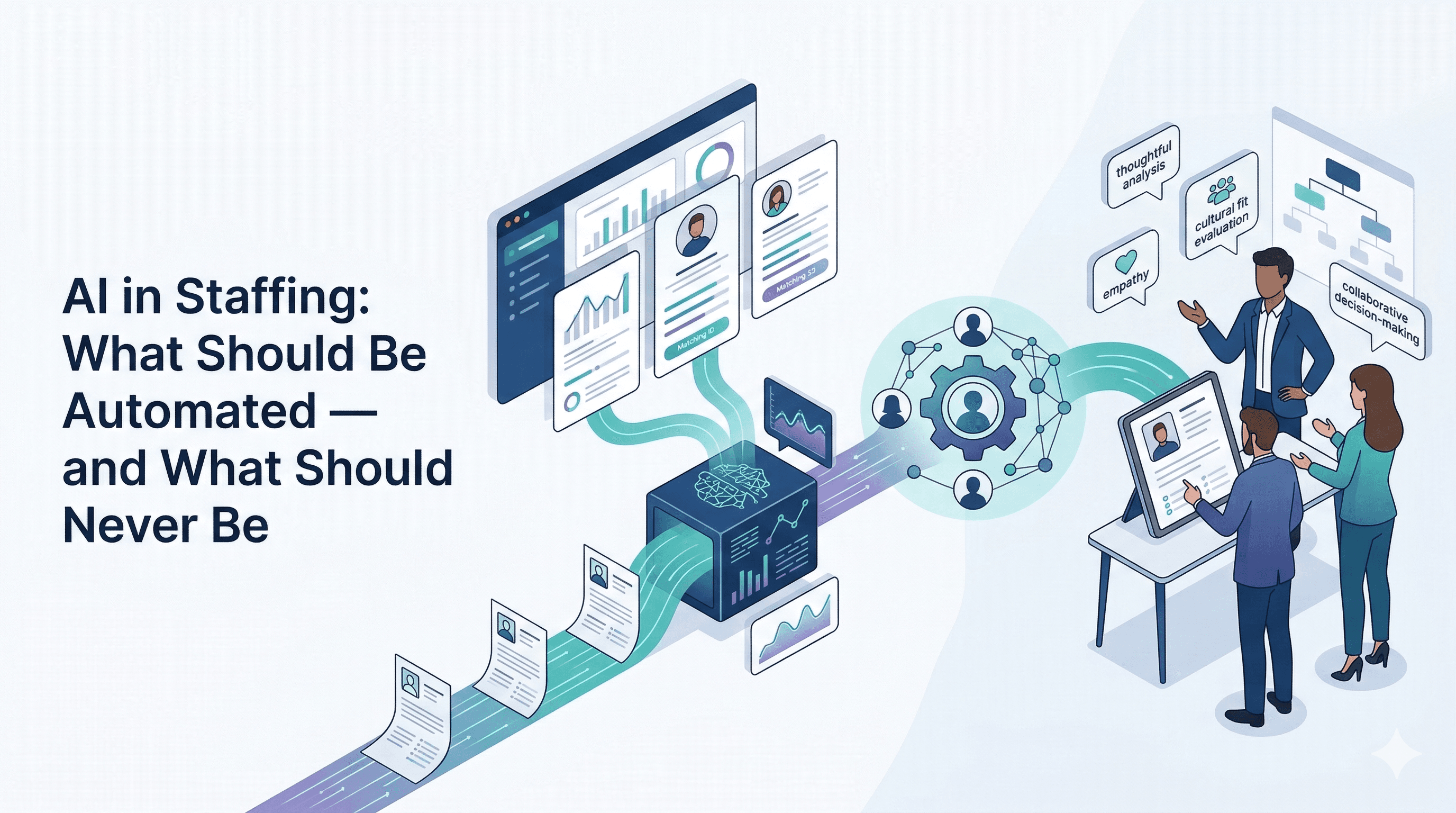
AI in Staffing: What Should Be Automated — and What Should Never Be
Author: TalentiFi-X Team
Artificial intelligence is no longer a future concept in staffing. It’s already here—screening resumes, ranking candidates, and influencing hiring decisions across industries. Yet, as AI adoption accelerates, one critical question often gets overlooked: Just because something can be automated, does it mean it should be? The future of staffing depends not on how much we automate—but on where automation belongs, and where it doesn’t.
 AI & Staffing
Why Traditional Staffing Is Broken in the Age of AI (And What Comes Next)
Author: TalentiFi-X Team
The staffing industry was built for a different era. An era where roles were local, talent pools were limited, and hiring timelines moved at a slower pace. For decades, that system worked well enough. But today, it’s under visible strain. Despite advances in technology, hiring has become slower, noisier, and more unpredictable for many organizations. Roles stay open longer. Resume volumes increase. Hiring decisions feel rushed—or endlessly delayed. The problem isn’t talent. The problem is that traditional staffing models haven’t evolved at the pace of the modern workforce.
 Modern Staffing
India's Hiring Market: Spring 2026 Snapshot
Author: Chetan Mangalwedhe, Founder & CEO, TalentiFi-X
India’s talent market in Spring 2026 is not moving slowly. It is evolving at a rapid pace. Tech hiring demand has increased by 14 percent year on year across Tier-1 cities. The average time to fill specialised roles has stretched to 38 days, and counter-offer acceptance rates have almost tripled. If your hiring playbook has not been updated in the last six months, it is already falling behind. Here is a closer look at what is happening across different sectors and what it means for your hiring strategy.