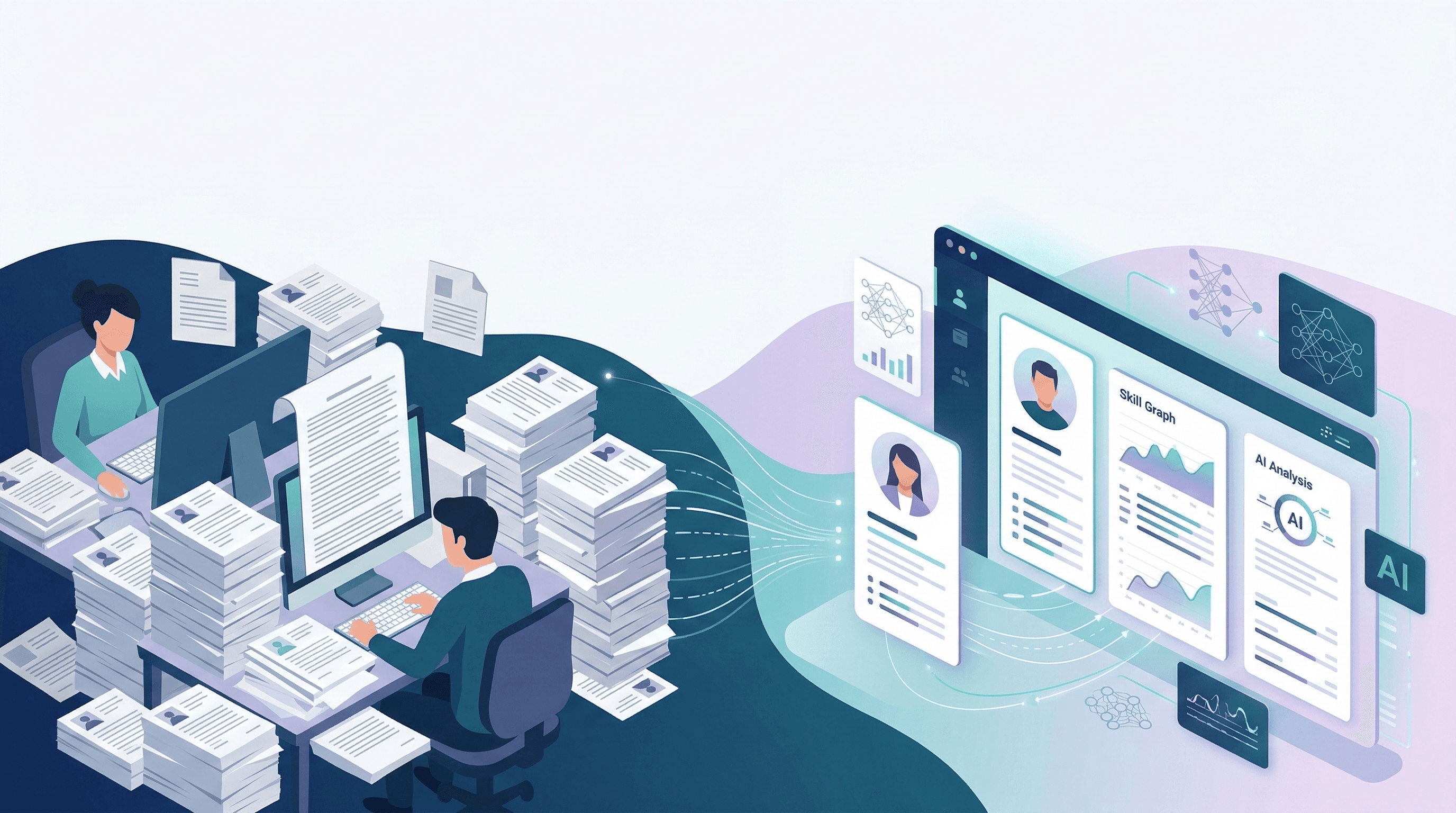
Why Traditional Staffing Is Broken in the Age of AI (And What Comes Next)
The staffing industry was built for a different era. An era where roles were local, talent pools were limited, and hiring timelines moved at a slower pace. For decades, that system worked well enough. But today, it’s under visible strain. Despite advances in technology, hiring has become slower, noisier, and more unpredictable for many organizations. Roles stay open longer. Resume volumes increase. Hiring decisions feel rushed—or endlessly delayed. The problem isn’t talent. The problem is that traditional staffing models haven’t evolved at the pace of the modern workforce.
Contents
The Reality of Hiring Today
The way companies work has fundamentally changed.
Teams are global and distributed, talent moves faster than ever, candidates evaluate employers as much as employers evaluate them, and AI and automation now influence nearly every business function.
Yet many staffing processes still rely on manual screening, high resume volume, and generic sourcing methods.
This mismatch between how the world works and how hiring is done is where most problems begin.
What’s Broken in Traditional Staffing
Traditional staffing models struggle today for a few key reasons.
Volume Over Clarity
Sending 20–30 resumes for a single role is often seen as effort. In reality, it creates confusion.
More resumes don’t lead to better decisions. They delay clarity and increase the risk of mis-hires.
Slow, Linear Processes
Hiring workflows were designed for a time when talent had fewer options.
Today’s top candidates often receive multiple offers within days, not weeks. Long hiring cycles now actively work against companies.
Limited Talent Reach
Many traditional models still operate within narrow geographic or platform boundaries, even as talent markets become global and borderless.
Inconsistent Evaluation
Without structure, screening quality varies widely. Cultural fit, intent, and long-term potential are often assessed too late or not at all.
Where AI Enters the Picture
AI didn’t break staffing. It exposed its weaknesses.
Used correctly, AI can dramatically improve early-stage hiring by screening large candidate pools quickly, identifying skill and experience patterns, reducing manual repetitive work, and eliminating noise early in the process.
However, AI alone does not fix hiring.
In fact, when AI is used to replace judgment instead of supporting it, it creates new risks, bias, misinterpretation, and loss of accountability.
The Mistake Companies Are Making with AI
Many organizations ask the wrong question. “Will AI replace recruiters?”
The better question is, “Where should AI be used and where should it not?”
AI is exceptional at speed and scale. It is not built for context, nuance, or human judgment.
Hiring decisions affect teams, culture, and lives. Those decisions require accountability, something technology cannot own.
What Comes Next: A Rebuilt Staffing Model
The future of staffing isn’t about choosing between AI and humans.
It’s about placing each where they add the most value.
AI should screen large talent pools, identify patterns and qualifications, and accelerate early-stage evaluation.
Humans should assess cultural fit and intent, evaluate communication and adaptability, and make final decisions with accountability.
This hybrid approach reduces noise, improves speed, and leads to better long-term outcomes.
In short, AI screens. Humans decide.
Why This Matters More Than Ever
Hiring mistakes today are more expensive than ever before.
They impact team morale, business momentum, leadership confidence, and long-term performance.
At the same time, the best talent expects clarity, speed, and respect throughout the hiring process.
Staffing models that fail to adapt risk losing both great candidates and competitive advantage.
The Future of Staffing Is Smarter, Not Louder
The next generation of staffing won’t be defined by more resumes, more automation, or more platforms.
It will be defined by better systems, clearer decisions, responsible use of AI, and human-led accountability.
Traditional staffing isn’t broken because people failed.
It’s broken because the system stopped evolving.
What comes next is a model built for today’s reality, faster, fairer, and more intentional.
Staffing. Rebuilt.
Frequently Asked Questions
Traditional staffing can still work, but only if it evolves to incorporate AI responsibly and reduce resume overload.
No. AI can support recruiters by handling scale and screening, but human judgment remains essential for hiring decisions.
Modern staffing combines AI-assisted efficiency with human-led evaluation to deliver faster, higher-quality hiring outcomes.