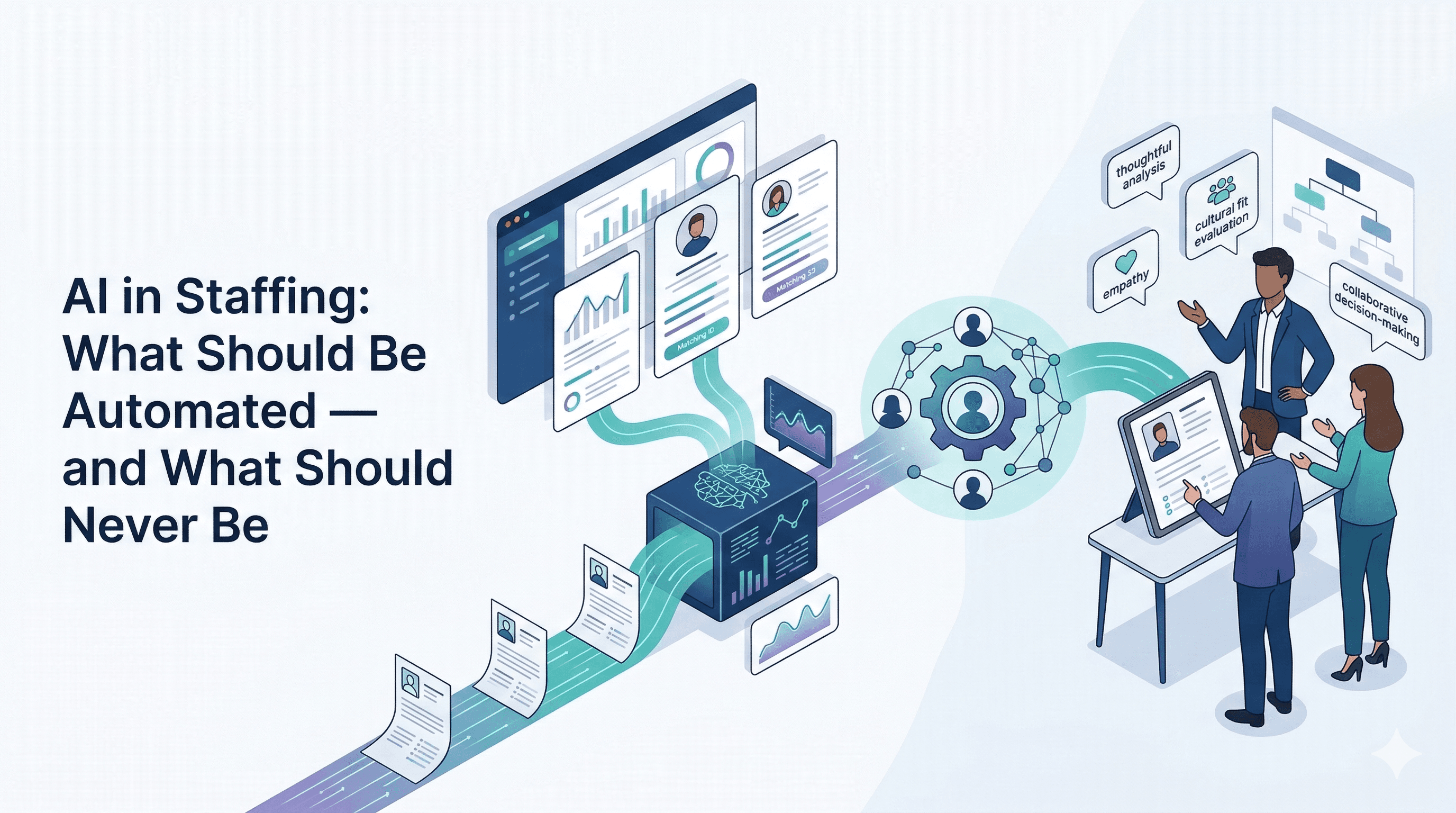
AI in Staffing: What Should Be Automated — and What Should Never Be
Artificial intelligence is no longer a future concept in staffing. It’s already here—screening resumes, ranking candidates, and influencing hiring decisions across industries. Yet, as AI adoption accelerates, one critical question often gets overlooked: Just because something can be automated, does it mean it should be? The future of staffing depends not on how much we automate—but on where automation belongs, and where it doesn’t.
Contents
Why AI Entered Staffing in the First Place
The staffing industry was under pressure long before AI arrived.
Resume volumes increased exponentially, hiring timelines grew longer, recruiters spent more time screening than evaluating, and candidates felt lost in the process.
AI emerged as a response to scale and speed—two areas where traditional staffing struggled most.
Used correctly, AI offers genuine value. Used blindly, it creates new risks.
What Should Be Automated in Staffing
AI is exceptionally good at tasks that require scale, repetition, and pattern recognition.
Here’s where automation makes sense.
High-Volume Resume Screening
AI can review thousands of profiles in seconds, identifying basic qualifications, experience patterns, and role relevance far faster than any human could.
This removes noise early and frees recruiters to focus on meaningful evaluation.
Skill and Experience Matching
AI can map resumes against job requirements, certifications, and career trajectories to highlight alignment and flag inconsistencies.
This improves accuracy in the early stages of hiring.
Initial Shortlisting
Automation can narrow large talent pools into a manageable shortlist, ensuring only relevant profiles move forward.
This is where AI creates speed without sacrificing structure.
Administrative Efficiency
Scheduling, documentation, compliance tracking, and workflow coordination are ideal for automation.
They reduce friction and improve the candidate experience without influencing decision quality.
What Should Never Be Automated
While AI excels at efficiency, there are areas where automation introduces risk rather than value.
These decisions shape people’s careers and organizations’ futures.
Cultural Fit and Team Alignment
Culture is context-dependent.
It involves communication style, values, adaptability, and interpersonal dynamics, factors that algorithms cannot truly interpret.
Automating cultural evaluation leads to superficial matches and long-term attrition.
Final Hiring Decisions
Hiring is not a data problem alone. It’s a judgment problem.
Final decisions require accountability, nuance, and responsibility, qualities that technology cannot own.
AI can inform decisions, but humans must make them.
Candidate Intent and Motivation
Why someone wants a role often matters more than whether they qualify on paper.
Understanding intent requires conversation, listening, and judgment, areas where human recruiters remain irreplaceable.
Ethical Accountability
When a hiring decision impacts a life, responsibility must be clear.
Automated decision-making without human oversight removes accountability and creates ethical and legal risk.
The Biggest Mistake Companies Make with AI
Many organizations frame AI adoption as an “either or” choice. AI or recruiters. Automation or judgment.
This is the wrong lens.
The real opportunity lies in combining the strengths of both.
AI should support hiring, not own it.
A Smarter Model: Human-Led, AI-Assisted Staffing
The most effective staffing models follow a clear principle.
AI should handle scale, speed, pattern recognition, and repetitive screening.
Humans should handle context, cultural alignment, decision-making, and accountability.
This balance creates hiring systems that are faster, fairer, and more reliable without sacrificing humanity.
In short, AI screens. Humans decide.
Why This Balance Matters Now
As AI tools become more powerful, the temptation to over-automate grows.
But hiring mistakes today are costly.
Mis-hires affect morale and productivity. Poor fit increases attrition. Slow or unclear processes lose top talent.
Organizations that automate without judgment risk scaling the wrong decisions faster.
Organizations that balance AI with human insight build teams that last.
The Future of AI in Staffing
AI will continue to evolve, and its role in staffing will expand.
But the future doesn’t belong to fully automated hiring.
It belongs to intelligent systems guided by responsible humans.
Staffing that works is not louder, faster, or more complex. It’s clearer.
And clarity comes from knowing exactly what should be automated and what should never be.
Staffing. Rebuilt.
Frequently Asked Questions
No. AI can assist recruiters by handling scale and screening, but human judgment is essential for hiring decisions.
Over-automation can lead to bias, poor cultural fit, lack of accountability, and legal or ethical concerns.
AI should support early-stage screening and efficiency, while humans lead evaluation, interviews, and final decisions.