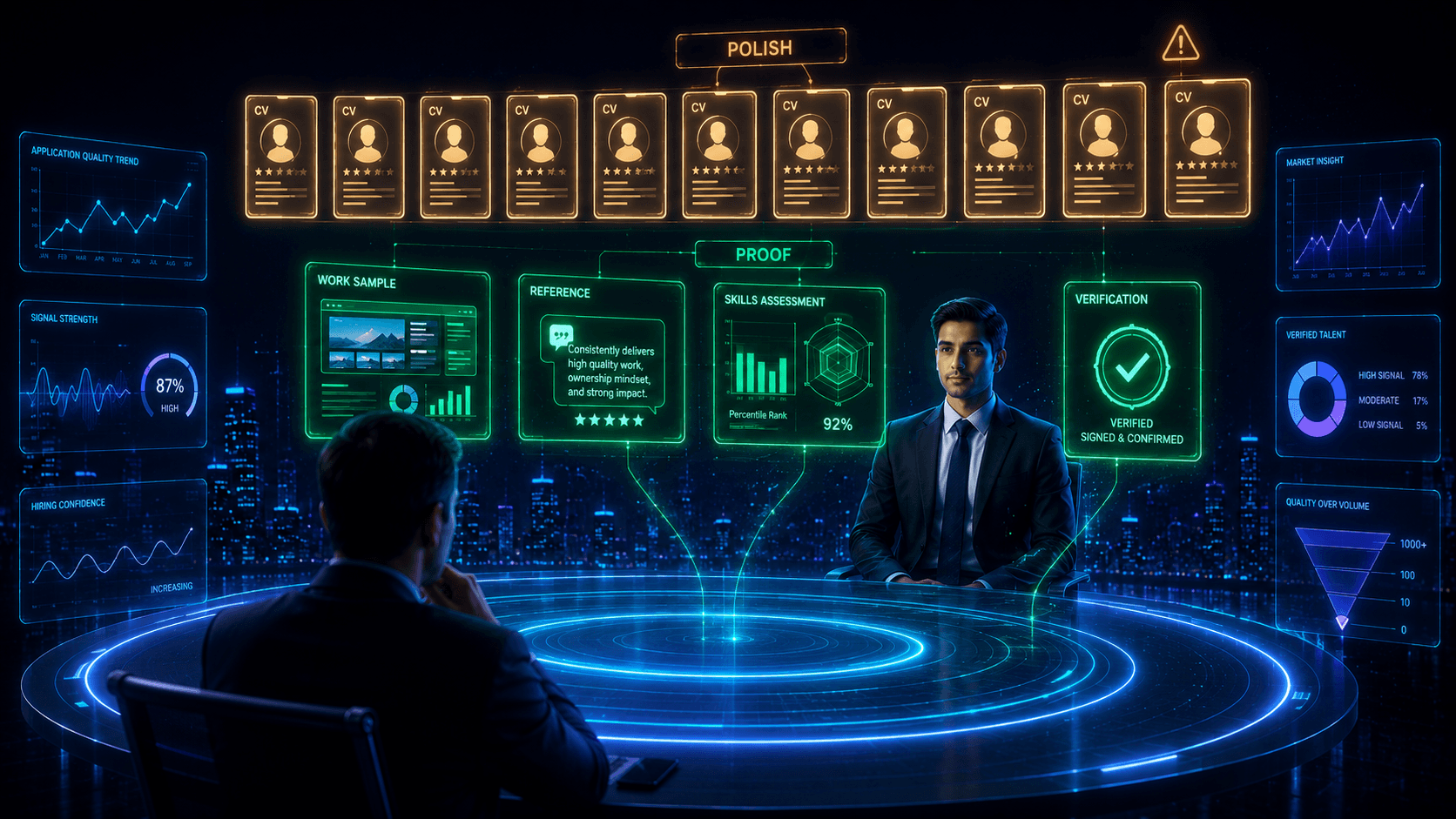
The Return of Trust in Hiring
As applications become easier to polish, hiring teams need stronger signals of real capability. Learn why skills, impact, references, judgment and trust are becoming more important in recruitment.
Contents
Hiring has always involved a degree of uncertainty. A CV is a representation. An interview is a performance. A reference is a perspective. A hiring decision is ultimately a judgment about what someone is likely to do in the future, based on what we can learn about their past.
What is changing is the quality of the signals available to employers. Candidates now have access to powerful tools that help them improve CVs, tailor applications, prepare interview responses and present their experience more effectively. That is not inherently a problem; better tools can help strong candidates communicate their capabilities more clearly. But there is a consequence. When presentation becomes easier for everyone to improve, presentation alone becomes less useful as a differentiator.
The question is no longer who looks strongest on paper. It is which signals we can trust.
What Does Trust Mean in Hiring?
Trust in hiring does not mean relying on instinct or personal chemistry. It means building enough credible evidence to make a confident employment decision. That evidence may come from demonstrated skills, verified work history, measurable past impact, structured interviews, work samples, credible references, consistent career narratives, and conversations that allow genuine depth to emerge.
The goal is not to eliminate uncertainty, because hiring will always involve uncertainty. The goal is to improve the quality of the signals used to make the decision.
The Hiring Signal Problem
Recruitment works through signals. A degree signals education. A job title signals responsibility. An employer brand signals experience in a particular environment. A CV signals career history. An interview signals communication, thinking and preparedness. References signal how others experienced working with the candidate. None of these signals is perfect, but when several independent signals point in the same direction, confidence increases.
The challenge begins when signals become increasingly easy to manufacture, optimise or standardise. A polished application used to require significant writing ability, time or professional assistance. Now almost anyone can produce a well-structured document quickly. Candidates can rehearse likely questions, improve wording and optimise their profiles before interacting with a recruiter.
There is nothing inherently wrong with this. The issue is signal compression. If almost every serious applicant can present themselves well, employers need additional ways to understand who can actually perform.
Polish Is No Longer Proof
A strong CV still matters. But a strong CV proves one thing most reliably: that the candidate submitted a strong CV. It does not automatically prove that they drove the outcomes described, that they operated at the level implied, that they can reproduce the same performance elsewhere, or that they possess the depth the new role requires.
This becomes increasingly important in specialised and senior hiring. A candidate can know the correct terminology, include the right keywords and structure achievements convincingly. Hiring quality depends on what exists behind those words. That is why modern recruitment needs to move from presentation assessment to capability verification.
From What Candidates Say to What Employers Can Verify
Hiring has traditionally relied heavily on self-reported information. Candidates tell organisations what they did, what they achieved, how they lead, what they know and how they solve problems. The strongest hiring processes then test those claims, and increasingly that second step is more valuable than the first.
The signals begin to shift toward four things that are harder to manufacture because they require evidence, consistency and context: demonstrated skills, past impact, credible references and real conversations.
1. Demonstrated Skills
The strongest way to understand whether someone can perform a task is often to observe how they approach it. That does not mean putting every candidate through lengthy assessments. It means creating opportunities to see capability rather than relying only on claims about capability.
Depending on the role, this could involve a work sample, a technical exercise, a portfolio, a case discussion, a presentation, a problem-solving conversation, or a structured discussion about previous work. The objective is not to create more recruitment stages. It is to make the existing stages more informative. A ten-minute conversation about how a candidate solved a real problem can tell you more than twenty minutes of rehearsed competency questions.
2. Past Impact
Experience and impact are not the same thing. Two candidates may both say they spent five years in product management. One may have managed an existing roadmap. The other may have built a new product line, navigated difficult stakeholder trade-offs and taken responsibility for commercial outcomes. Same job category, very different level of impact.
Instead of asking only what someone was responsible for, hiring teams can ask what changed because they were there. What did the candidate build, improve, fix, scale, save, launch, transform or influence? The more concrete the answer, the stronger the signal.
3. Credible References
Reference checks are sometimes treated as a final administrative step, which underuses them. A credible reference can help verify scope, performance, working style, leadership behaviour, strengths, areas for development, and the environment in which someone performed best.
The value of a reference is not simply whether someone says the candidate was good. It is the detail. Can the referee describe how the candidate handled difficult situations? What did colleagues rely on them for? How did they perform under pressure? Would the referee hire them again, and what type of role should they take next? Specificity creates trust. Generic praise does not.
4. Real Conversations
As recruitment becomes more digital, genuine conversation may become more valuable rather than less. Not because technology is bad, but because many digital signals can be standardised. A thoughtful conversation reveals things that rarely appear in a CV.
- How does someone reason when they do not immediately know the answer?
- Can they explain complexity simply?
- Do they understand why a past decision worked?
- Can they acknowledge mistakes?
- Can they distinguish personal contribution from team achievement?
- Can they ask intelligent questions about the opportunity?
These are powerful indicators of depth, and they are difficult to reduce to a keyword match.
The Paradox: More Digital Hiring Increases the Value of Human Signals
This is one of the most interesting consequences of hiring technology. As systems become better at creating, screening, matching, ranking, summarising and organising information, the signals that cannot be easily commoditised become more valuable: reputation, trust, judgment, relationships and demonstrated capability.
The more digital the hiring environment becomes, the more employers may value signals rooted in authentic human experience. That does not mean returning to old-fashioned, unstructured recruitment. It means using technology for what it does well while strengthening the areas where human evaluation creates better evidence.
The CV Is Not Dead
There is a temptation to frame every change in recruitment dramatically. The CV is dead. The interview is dead. The recruiter is dead. None of these claims is particularly useful. The CV remains an efficient way to understand someone's career history, the interview remains useful, and recruiters remain essential.
What is changing is the weight we place on each signal. A CV may become the starting point rather than the proof. An interview may need to move beyond rehearsed questions. References may become more meaningful, work samples may carry more weight, talent networks may become more important, and recruiters may increasingly be valued for their ability to interpret context rather than simply process applications.
Trust Matters Most in Senior and Specialised Hiring
The more important the role, the more expensive weak signals become. For a senior hire, a polished CV can conceal significant differences in actual capability. Titles are not standardised across organisations; a vice president in one company may have broader responsibility than a senior vice president elsewhere. A leader may have worked inside a successful business without being the person responsible for that success. A candidate may have participated in a transformation without leading it.
Senior recruitment therefore requires deeper verification. Who did the candidate influence? What decisions did they own? What changed under their leadership? What did former colleagues trust them to handle, and why did their organisation give them larger responsibilities? The higher the stakes, the more hiring becomes a process of building confidence through evidence.
Trust Also Matters in Passive Candidate Recruitment
There is another side to this conversation. Employers need to trust candidates, but candidates also need to trust employers. This is especially true when engaging passive talent. A strong professional who is already employed is being asked to consider real disruption: leaving a known manager, changing teams, risking reputation, potentially relocating, giving up accumulated trust, and joining an organisation they may know relatively little about.
That decision requires confidence, so recruitment cannot become a one-way verification exercise. Is the role genuinely what it has been presented as? Does the hiring manager understand what they want? Is the organisation transparent about expectations? Can the recruiter answer difficult questions? Is the process respectful, and are commitments consistent? Trust is reciprocal.
The Return of Reputation
As formal application signals become easier to polish, professional reputation becomes more important. Reputation is built slowly. It comes from people who have worked with you, projects you have delivered, leaders willing to recommend you, colleagues who seek you out again, communities where your expertise is recognised, and a body of work that exists beyond a single job application.
For many specialised professionals this already matters. A respected engineer may be known within a technical community. A sales leader may be known by customers and former colleagues. A senior executive may be known across an industry. A recruiter who understands these networks gains information that a CV database alone cannot provide.
Why Referrals May Become More Valuable
Employee referrals have always been valuable because they introduce an additional signal: someone is willing to attach their reputation to this candidate. That does not mean referred candidates should bypass assessment, nor that referrals are inherently fairer or more accurate. Handled poorly, they can create their own biases.
But the underlying principle is useful. Recruitment becomes stronger when hiring decisions draw on multiple independent sources of evidence. A CV says one thing, a structured interview says another, a work sample adds another, and a credible recommendation provides another. When they align, confidence grows.
Trust Should Not Mean Hiring People We Know
This distinction is critical. A trust-based hiring model should not become a closed network where organisations only hire people already connected to existing employees. That would reduce access and diversity rather than improve hiring.
The objective is not to trust people because we know them. It is to build trustworthy evidence about people we do not.
That requires structured assessment, transparent criteria and multiple signals. Trust should improve fairness. It should not replace it.
Why Structured Interviews Matter More, Not Less
If candidates can prepare more effectively, interview design needs to improve. Generic questions about a candidate's biggest weakness, where they see themselves in five years, or a request to tell me about yourself can still have conversational value, but they often generate highly prepared responses.
A stronger structured interview focuses on evidence. Ask a candidate about a decision they made with incomplete information, then probe. What information was missing? What options did they consider? What happened, and what would they do differently? Who disagreed with them, and what was their personal contribution? The depth of the follow-up matters more than the cleverness of the first question.
AI Can Help Hiring. Trust Still Needs Accountability.
AI can strengthen recruitment in meaningful ways. It helps teams search larger talent markets, identify patterns, summarise candidate information, support skills matching, reduce administrative work and improve recruiter productivity.
But employers should be careful not to confuse algorithmic output with objective truth. A recommendation, ranking or match score still needs interpretation. The more consequential the hiring decision, the more important it becomes that humans understand why a candidate is being advanced or rejected. Technology can generate signals. Someone still needs to own the judgment.
The Recruiter Becomes a Signal Interpreter
This may be the most valuable role of the modern recruiter: not simply finding information, but interpreting it. Which signals are meaningful and which are superficial? What is missing, and what requires verification? Where does the candidate's context differ from the hiring manager's assumptions? What does the reference reveal that the CV does not, and what does the career pattern suggest? Where is there genuine evidence of capability?
This requires judgment, and judgment becomes more valuable as information becomes more abundant.
Hiring Teams Need Better Signal Architecture
A strong hiring process should deliberately decide which signals matter at each stage, rather than letting one impressive interview dominate the decision.
Stage 1: Profile
Use the CV to understand broad career history and potential relevance.
Stage 2: Recruiter conversation
Understand motivation, context, career trajectory and basic alignment.
Stage 3: Skills evidence
Validate the most important capabilities the job requires.
Stage 4: Hiring manager evaluation
Assess depth, judgment and the ability to solve relevant business problems.
Stage 5: References
Verify past performance, leadership behaviour and working context.
Stage 6: Decision
Combine evidence across signals. The objective is not more process. It is better evidence per stage.
What Should Employers Measure?
If trust and capability matter, recruitment metrics need to reflect that. Beyond applications and time-to-fill, organisations can measure shortlist-to-interview conversion, which shows whether recruiters are sending genuinely relevant candidates. Interview-to-offer conversion, which shows whether assessment is aligned with sourcing. Offer acceptance, which shows whether candidates trust and value the opportunity. Quality of hire, which shows whether the person performs after joining. Early attrition, which shows whether expectations and fit were understood correctly. Hiring-manager confidence, which shows whether the process provided enough evidence to make a sound decision. And reference consistency, which shows whether external signals align with the candidate's own claims.
Good recruitment does not simply create more information. It creates better confidence.
The Future of Hiring Will Be About Verification
The next phase of recruitment will not be won by the company with the biggest database, nor by the candidate with the most polished application, nor by the recruiter who can send the most profiles. The differentiator will increasingly be the ability to identify and verify genuine capability.
That means asking better questions, looking for evidence, understanding context, checking reputation, assessing skills, building real relationships and applying human judgment where it matters. Because when presentation becomes abundant, trust becomes scarce. And scarce things become valuable.
The Return of Trust in Hiring
The future of hiring is not a rejection of technology. It is a recognition of what technology changes. When candidates can present themselves more effectively, recruiters need better ways to distinguish presentation from performance. When information becomes easier to generate, verification becomes more important. When hiring becomes more digital, authentic human signals become more valuable.
The CV is not dead. It is simply no longer enough on its own. The strongest hiring decisions will increasingly be built around skills, impact, references and real conversations, and around one fundamental question: can we verify capability, not just presentation?
Talk to TalentiFi-X About Verified Hiring
TalentiFi-X builds evidence-led assessment and reference processes for senior and specialised hiring across India and the US, using our Human Led, AI Assisted methodology, with human experts in every decision that matters.
Human Led. AI Assisted. Bengaluru and Houston.
Book a 15-minute discovery call at talentifix.com.
Frequently Asked Questions
Trust in hiring means having credible evidence that supports a hiring decision. It can include demonstrated skills, verified experience, structured interviews, references, work samples and consistent evidence of past impact.
As candidates gain access to better tools for preparing CVs, applications and interviews, presentation becomes easier to improve. Hiring teams therefore need stronger signals that help them verify genuine capability and past performance.
CVs remain useful for understanding career history and initial relevance. However, they should be treated as one hiring signal rather than definitive proof of capability.
The strongest signals vary by role, but useful indicators can include demonstrated skills, measurable past impact, structured interview evidence, credible references, relevant work samples and consistent professional reputation.
References can help employers validate a candidate's responsibilities, performance, leadership style and working context. Detailed references provide more value than generic confirmations of employment.
AI can support sourcing, matching, screening and information analysis. However, hiring teams still need human oversight to interpret results, verify evidence and remain accountable for employment decisions.
Capability verification is the process of testing whether a candidate can genuinely perform the work required. This may involve structured interviews, work samples, skills assessments, portfolio reviews, reference checks or evidence of past outcomes.
No. Referrals can be one useful hiring signal, but trust-based hiring should combine multiple forms of evidence and should not restrict opportunities only to people within existing professional networks.
How TalentiFi-X can help
We hire AI, ML, cybersecurity and GCC talent across India and the US: human-led and AI-assisted, with a shortlist of a few well-matched candidates instead of a pile of CVs.